The Trump administration on June 17 literally cut off a valuable lifeline for LGBTQ+ youth: specialized support at the national 988 Suicide & Crisis Lifeline. However, LGBTQ+ youth and other LGBTQ+ help seekers in Tompkins County can continue to be served through various options and workarounds.
Since the federally funded 988 hotline was launched in 2022, LGBTQ+ youth callers could “Press 3” to be routed to a counselor who specializes in LGBTQ+ support at The Trevor Project. The option was based on research and data showing that gay and transgender people experience distinct mental health challenges and disproportionately high suicide rates.
Nonetheless, other options for confidential support, answers, and information remain for those seeking LGBTQ+ specialized support, according to Tiffany Bloss, executive director of the Suicide Prevention & Crisis Service of Tompkins County (SPCS), which staffs the 988 call center for Tompkins and 16 surrounding counties.
SPCS notes that support is still available directly at The Trevor Project, an advocacy organization that provides a hotline for LGBTQ+ youth up to age 25. To reach The Trevor Project LGBTQ+ help seekers dial (866) 488-7386 or text START to 678-678 to be connected with a specialized counselor.
Moreover, Bloss explained, SPCS operates a separate 24/7 LGBTQ+ Peer Support Line at (607) 276-1771. SPCS describes the Peer Support Line as “a safe space for members of the LGBTQ+ community—any age and any identity, or those who are worried about a loved one—to reach out and speak directly with a trained, culturally competent peer of the community who understands the journey they are experiencing.”
“We are here for you. We want you to know there is still support available during these tumultuous times,” Bloss said.
According to the U.S. Substance Abuse and Mental Health Services Administration, the government ordered the termination of 988’s LGBTQ+ function to “focus on serving all help seekers.”
The New York Times reported that the move appeared in line with the Trump administration’s broader efforts to eliminate services for and legal recognition of transgender people.
Trump’s White House Office of Management and Budget has previously described the LGBTQ+ function as “a chat service where children are encouraged to embrace radical gender ideology by ‘counselors’ without consent or knowledge of their parents,” the newspaper reported.
The New York Times noted that the Trump administration’s efforts have also included cutting funding for research on LGBTQ+ health, and executive orders seeking to eliminate diversity, equity and inclusion efforts, which affect LGBTQ+ people as well as people of color and others.
But Bloss said that her organization is undeterred.
“What is happening to the LGBTQ+ community right now is devastating and our hearts go out to everyone affected—members of the community, their families and other allies, the staff who support this specific service, and the ripple goes on,” she said.
“We will not stop advocating for the rights of the LGBTQ+ community. We hear you. We see you. You matter. The world is an incredibly scary place right now. Reach out and talk with us. You are not alone in this.”
The Trevor Project: Dial (866) 488-7386 or Text START to 678-678.
LGBTQ+ Peer Support Line: Dial (607) 276-1771.
Trans Lifeline: Dial (877) 565-8860.
SAGE National Elder Hotline: Dial (877) 360-5428.
If you or someone you know feels the need to speak with a mental health professional, you can call or text the 988 Suicide and Crisis Lifeline at 9-8-8, or contact the Crisis Text Line by texting HOME to 741-741.
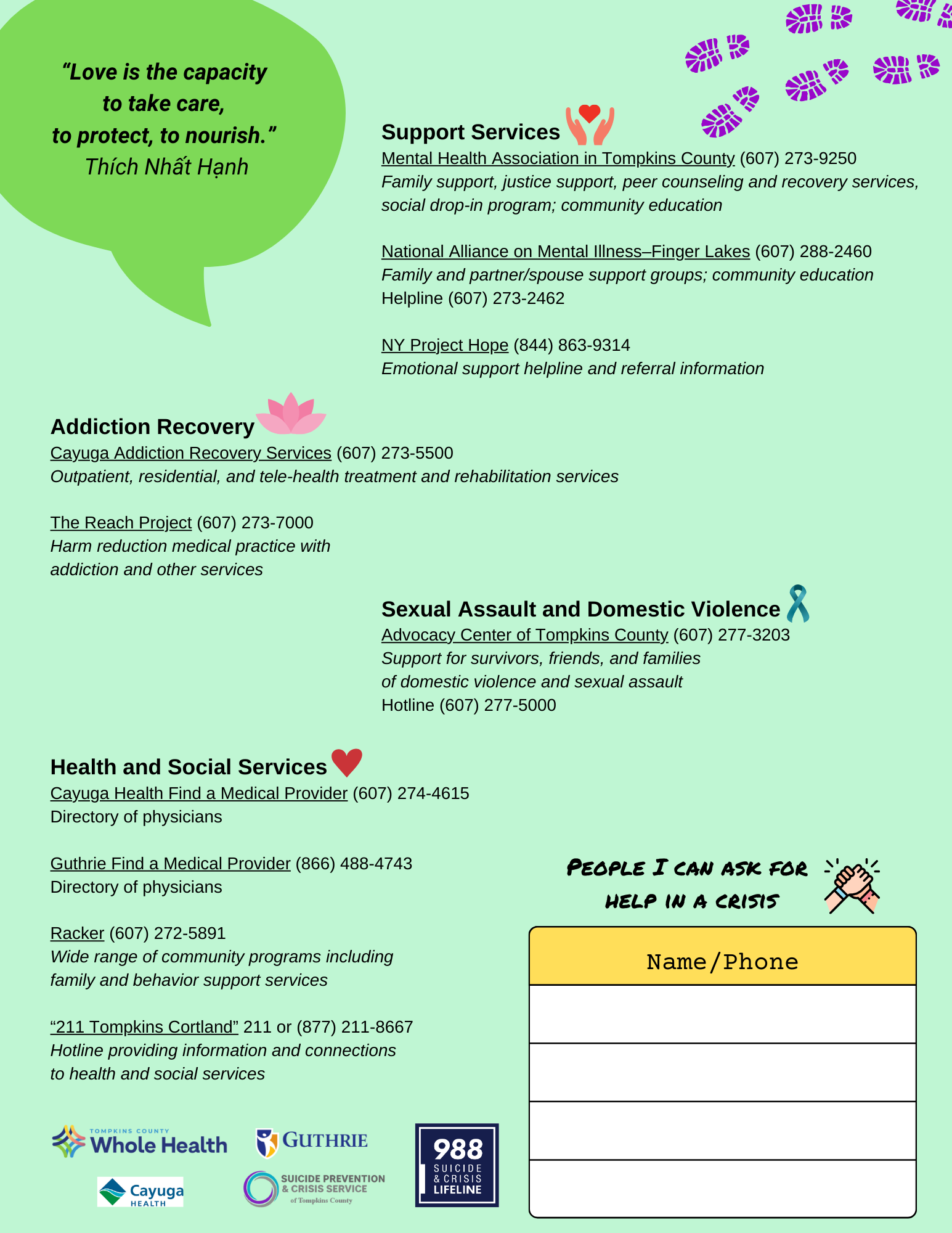
The guide is a hyperlinked listing of essential local services for suicide prevention, psychotherapy, addiction recovery, sexual assault and domestic violence, and support groups. Click on the links for more detailed information about available services and programs.
The Sophie Fund is sponsoring free registration—and free continuing education credits (CEUs)—for healthcare professionals in Tompkins County to attend a two-day online training in suicide prevention featuring some of the nation’s leading experts.
Free registration and free continuing education credits for physicians, primary care clinicians, health and mental health clinicians, and clinical social workers serving Tompkins County is supported by a grant from The Sophie Fund.
To request a registration code for free registration, healthcare professionals can email The Sophie Fund at thesophiefund2016@gmail.com providing their 1) name, 2) email address, 3) degree level, and 4) place of employment (or name and address of practice, if self-employed).
Scott MacLeod, co-founder of The Sophie Fund, said his organization’s sponsorship of the Wellness Institute program for the fourth year in a row is intended to advance the Zero Suicide Model with healthcare providers. Thus far, The Sophie Fund has provided the free training for 180 clinicians in Tompkins County, including the counseling center staffs of Cornell University and Ithaca College.
Zero Suicide is an emerging standard designed to save lives by closing gaps in the suicide care offered by healthcare providers. The model provides a practical framework for system-wide quality improvement in areas including training staff in current best practices, identifying at-risk individuals through comprehensive screening and assessment, engaging at-risk patients with effective care management, evidence-based treatments, and safe care transition.
Suicide Safer Care in Clinical Practice: Incorporating Current Best Practices
Wednesday, March 19, 1-5 p.m.
Understanding Suicide to Prevent Suicide: A Clinical Framework
E. David Klonsky, PhD, Professor in the Department of Psychology, University of British Columbia
Jill Harkavy-Friedman, PhD, Senior Vice President of Research, American Foundation for Suicide Prevention
New-Generation Treatments (CRP, BCBT, etc.)
Craig Bryan, PsyD, ABPP, Trott Gebhardt Philips Endowed Professor and Professor of Psychiatry and Behavioral Health, Ohio State University College of Medicine
Assessment, Safety Planning, and Treatment Pathways
Gillian Murphy, PhD, New York-based psychotherapist; former Assistant Deputy Director for the National Suicide Prevention Lifeline (now 988)
Integrating Firearm Safety Discussions in Clinical Practice
Christopher Knoepke, PhD, MSW, LCSW, Research Assistant Professor, University of Colorado Anschutz Medical Campus.
Clients with Suicide Bereavement
Noam M. Schneck, PhD, Assistant Professor of Clinical Medical Psychology (in Psychiatry), Columbia University’s Department of Psychiatry and the New York State Psychiatric Institute
Thursday, March 20, 1-5 p.m.
The Human Element: Engaging Suicidal Clients
Jonathan Singer, PhD, LCSW, Professor, Loyola University Chicago School of Social Work
Creating Safe Spaces for Suicidality Disclosure
Lindsay Sheehan, PhD, Assistant Professor of Psychology and Associate Director of the Center on Health Equity, Education, and Research, Illinois Institute of Technology
Post-Crisis Reintegration
Marisa Marraccini, PhD, Tarbet Faculty Scholar in Education and an Associate Professor of School Psychology, University of North Carolina at Chapel Hill’s School of Education
Adapting Suicide Prevention for Telehealth
Lauren Khazem, PhD, Research Assistant Professor and clinical psychologist in the Department of Psychiatry and Behavioral Health, Ohio State University Wexner Medical Center
Addressing Substance Use in Suicide Prevention
Christina M. Sellers, PhD, LCSW, Associate Professor and Director of the Center for Innovation in Behavioral Health Education and Research, School of Social Work, Simmons University
Sleep-Focused Approaches to Youth Suicide Prevention
Sally Weinstein, PhD, Associate Professor of Clinical Psychiatry and Associate Director of the Center on Depression and Resilience, University of Illinois College of Medicine
Ask the Experts: What Works in Suicide Care (Q&A Session)
David Jobes, PhD, ABPP, Professor of Psychology and Associate Director of Clinical Training, Catholic University of America; Creator and Developer, Collaborative Assessment and Management of Suicidality (CAMS)
David A. Brent, MD, academic chief of child and adolescent psychiatry, UPMC Western Psychiatric Hospital
Jill Harkavy-Friedman, PhD, Senior Vice President of Research, American Foundation for Suicide Prevention
Learning Objectives:
Describe a model for understanding suicide and list factors that contribute to increased suicide risk.
Discuss how clinicians can engage in suicide prevention in their clinical practice.
Describe the suicidal mode and identify the mechanisms targeted by newly developed treatments in suicide prevention.
Identify core principles that can guide the suicide assessment process and brief interventions to implement to maintain client safety.
Articulate the role of firearms in suicide and how to integrate firearm safety conversations into suicide prevention efforts.
Explain the unique emotions that typify suicide bereavement and an approach to facilitate emotional acceptance.
Identify suicide-focused care models that fit a clinician’s clinical approach best and ways they can utilize their emotional reactions while working with suicidal individuals.
Describe client perspectives on disclosure of suicidality and strategies to increase comfort in disclosure.
Explain considerations for supporting students returning to school following suicide-related crises and how best practices for student reintegration may be generalized for community reintegration of individuals in all life stages.
Identify telehealth adaptations of suicide prevention strategies and how they may be implemented. (Describe imminent suicide risk assessment and responses.)
Explain the relationship between substance use and suicide and how substance use is a risk factor for suicide.
Describe developmental changes in sleep in adolescence, how to assess sleep quality in youth, and intervention strategies to improve sleep in adolescents that may be relevant for suicide prevention.
Demonstrate how to ask a client if they are experiencing suicidal thoughts, incorporate one new practice for suicide prevention, and develop a practice plan to put in effect when a person states they have been thinking about suicide.
Our kids are telling us: “We are struggling with mental health.” From the Covid-19 disruptions, academic pressures, and addictive social media to navigating adolescence in a time of political and economic uncertainty, it is a tough time for many to be young in America.
DOWNLOAD: Mental Health Support & Suicide Prevention for Schools in Tompkins County
National and local surveys of school students reflect the seriousness of the crisis. In a survey from the Centers for Disease Control and Prevention, 40 percent of high schoolers said they experienced persistent feelings of sadness or hopelessness. Twenty-nine percent reported poor mental health, and 20 percent said they had considered taking their own lives.
A survey of high school and middle school students in Tompkins County came up with similar patterns. Forty-seven percent said they felt anxious or worried on most days, 35 percent felt sad or depressed on most days, and 34 percent said that “sometimes I think life is not worth it.”
Such data prompt a call to action, to intensify our efforts to safeguard the mental well-being of children growing up in our precarious digital age.
In that spirit, the new resources guide was created by the Suicide Prevention & Crisis Service of Tompkins County, American Foundation for Suicide Prevention Greater Central New York, National Alliance on Mental Illness Finger Lakes, Mental Health Association in Tompkins County, and The Sophie Fund.
“Mental health and well-being start with our youth. At a young age, understanding warning signs and developing coping skills can provide a foundation for supportive strategies to be carried into adulthood. Talking about suicide is how we start supporting our young people,” said Tiffany Bloss, executive director of the Suicide Prevention & Crisis Service.
“Gaining an educated understanding of how to have conversations around crisis and suicide can save lives. Dedicating a matter of hours could save a youth’s life. We need to invest the time. We offer a variety of suicide prevention trainings and workshops at no cost to those who want to learn more.”
After providing a brief “Mental Health and Suicide 101” introduction, the resources guide details the education and training that the local organizations are ready to present to Tompkins school administrators, teachers, students, and parents.
If you have a comment, concern, or suggestion about mental health in Tompkins schools, please feel free to email it to The Sophie Fund: thesophiefund2016@gmail.com.
The resources guide compiles handbooks and toolkits to assist Tompkins schools in developing mental health promotion and bullying prevention programming as well as suicide prevention strategies in their school communities. The guide points to recommendations for youth use of social media issued by the U.S. Surgeon General and the American Psychological Association.
The organizations launched the resources guide in last September during Suicide Prevention Month and immediately distributed copies to the superintendents of the seven school districts in Tompkins County.
At the same time, the organizations requested an opportunity to meet directly with the superintendents and their leadership teams to provide a presentation on the support services available and respond to any concerns or questions they may have.
Tompkins school districts include Ithaca City School District; Lansing Central School District; Trumansburg Center School District; Newfield Central School District; Groton Central School District; Dryden Central School District; and TST BOCES. (As of late January 2025, three school districts had responded positively to the request.)
If you or someone you know feels the need to speak with a mental health professional, you can call or text the 988 Suicide and Crisis Lifeline at 9-8-8, or contact the Crisis Text Line by texting HOME to 741-741.
Mental health leaders in Tompkins County provided information about community services during The Sophie Fund’s 9th Annual Ithaca Cupcake Baking Contest on October 19.
Ithaca Free Clinic’s Norbert McCloskey briefs Cornell students about his agency’s work
Speaking at the Awards Ceremony, Norbert McCloskey, executive director of the Ithaca Free Clinic, which provides healthcare to individuals regardless of ability to pay, expressed gratitude for the support the agency receives from the community.
“I have had the honor for number of years now to work with an organization that does all that it can to make sure that people can access the healthcare that they need. We’re able to do that because all of our services are provided by community volunteers—everyone from MDs all the way down to the kind lady who comes in once a week and waters our plants,” McCloskey said.
Ithaca Free Clinic
McCloskey noted the connection between healthcare and mental health.
“Nothing really creates anxiety in the life of an individual than being ill and not being able to see a doctor, not being able to get the care that they need. Whether that care is primary family practice care, or acupuncture, or herbalism, or chiropractic, or occupational therapy, or seeing an optometrist to get the eyewear that they need in order to live a full and productive life.
“You probably wouldn’t be surprised to know that a significant number of people who come to our doors do suffer from a variety of mental health conditions. We are able to help them recognize that, and then steer them toward this vast array of organizations that we have in our community to get help that they need to live full, productive, happy, and joyful lives.”
Tiffany Bloss, executive director of the Suicide Prevention & Crisis Service of Tompkins County, said that her agency has been able to expand its services beyond its role as a local call center for the national 988 Suicide Prevention and Crisis Lifeline.
Suicide Prevention & Crisis Service of Tompkins County
She told the Awards Ceremony audience that SPCS now handles calls from 16 other New York State counties in addition to Tompkins County. She said her agency also launched a 24-hour “warm line” for people who are not in crisis yet need a person to talk to, as well as a 24-hour LGBTQ peer support line.
“It is so incredibly necessary. We need to have everyone talking about mental health all the time,” she said.
Bloss pointed people to SPCS’s newly redesigned website, “an incredible resource for mental health.”
“We really just want to get the word out and get people talking about mental health and suicide. Make it not a scary topic. We need to look at it like we look at our physical health,” she said.
Tompkins County Bullying Prevention Task Force
Mental Health Association in Tompkins County
American Foundation for Suicide Prevention — Greater Central New York
National Alliance on Mental Illness — Finger Lakes


You must be logged in to post a comment.