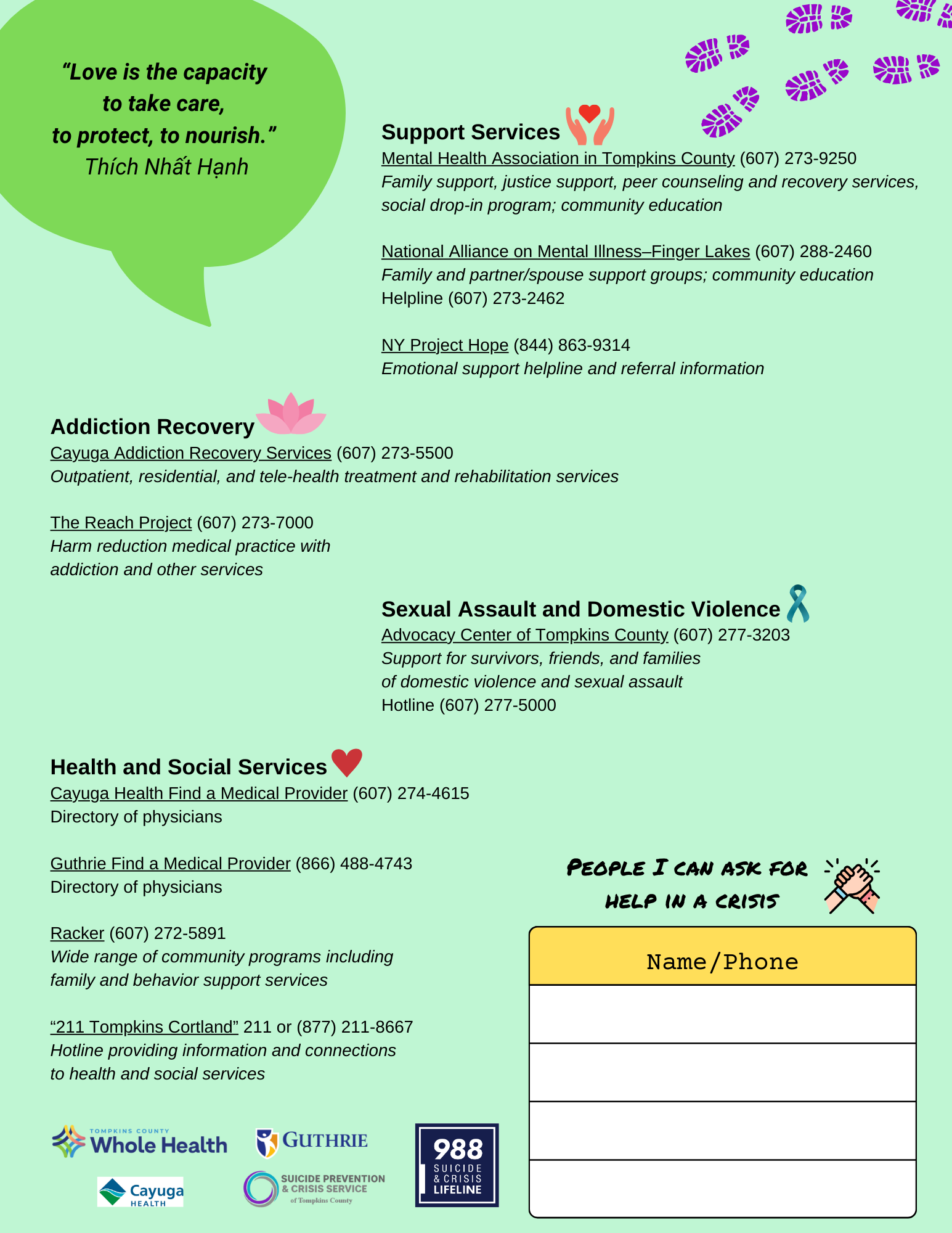
UPDATED Tompkins Mental Health Support Resources

The Mental Health Support and Crisis Services resource for Tompkins County has been updated for 2026.

The guide is a hyperlinked listing of essential local services for suicide prevention, psychotherapy, addiction recovery, sexual assault and domestic violence, and support groups. Click on the links for more detailed information about available services and programs.

The brief guide is compiled every year by The Sophie Fund in collaboration with Tompkins County Whole Health, Cayuga Health, Guthrie, and the Suicide Prevention & Crisis Service of Tompkins County.

DOWNLOAD PDF DOWNLOAD SHAREABLE Page 1 Page 2

Click HERE for other mental health guides compiled by The Sophie Fund

Where to Find Help for Your Mental Health

The Mental Health Support and Crisis Services resource for Tompkins County has been updated for 2025. The brief guide is compiled every year by The Sophie Fund in collaboration with Tompkins County Whole Health, Cayuga Health, Guthrie, and the Suicide Prevention & Crisis Service of Tompkins County.

The guide is a hyperlinked listing of essential local services for suicide prevention, psychotherapy, addiction recovery, sexual assault and domestic violence, and support groups. Click on the links for more detailed information about available services and programs.

DOWNLOAD PDF DOWNLOAD SHAREABLE Page 1 Page 2

Click HERE for other brief mental health guides compiled by The Sophie Fund

Group Support in Tompkins County

To me, the philosophy behind mental health support groups aligns with Platonic wisdom: inquiry, dialogue, and collective reasoning leads to knowledge, truth, and justice. Struggling alone can be much more difficult than sharing lived experience with peers in a mutually beneficial atmosphere, according to Melanie Little, director of Training and Peer Education at the Mental Health Association in Tompkins County.

Team members at the Mental Health Association in Tompkins County

“We have a lot to learn from each other,” said Little. “Your lived experience is expertise, and that is mutually beneficial. It’s really empowering because we can help other people.”

Peer support groups are commonly facilitated by people who themselves have lived experience with mental health conditions and are trained to assist others. They are known as certified peer specialists. Group therapy, on the other hand, is more often provided by licensed therapists with specific therapeutic interventions.

As a peer specialist, bi-weekly facilitator, and group therapy veteran, I strongly believe that group support particularly and significantly builds confidence in attendees. Knowing that others go through similar experiences confirms our struggles as real, validates that we matter, and promotes greater peace with a society that may rarely seem to understand. Peer interaction cultivates a mutual emotional safety net, enabling participants to see past the stigma, to reclaim their lives.

Group programs vary tremendously in material, style, and message. Most fit into one of several categories. Psychoeducational groups educate people about their condition, offering effective coping skills. Cognitive-Behavioral Group Therapy helps people to recognize patterns of thought that negatively influence emotions and behaviors. Skills development is meant to increase overall function in the world. Support groups entail people converging on similar problems, assisting each other through feedback. Interpersonal groups focus on social skills.

According to the American Psychological Association, group therapy is at least as effective as individual therapy. Cited research suggests that expanding group therapy initiatives in the US would save more than $5.6 billion, and free the schedules of about 34,500 therapists for individual therapy. The research found group therapy effective for a myriad of mental illnesses, including those marked by anxiety, depression, mood cycling, psychosis, substance abuse, and eating disorders. Robust effects on alliance and cohesion were highlighted.

Overall, group therapy is an excellent option for those who want to surpass the limits of individual therapy, or those who would stand to benefit from a peer experience. Little said that it’s particularly valuable because “we can feel so much shame, so much isolation.”

Many support group options are available in Tompkins County.

The Mental Health Association in Tompkins County offers several free group programs. Psychosocial Support, for adults with mental health challenges, promotes rehabilitation within the community, helping people forge strong bonds with peers. Peer Support/Advocacy also serves adults, consisting of casual and structured activities, both in individual and group form work. The focus is on mental health recovery, goal planning, learning skills, progress monitoring, self-help and self-advocacy, hope, and community participation. Family Peer Support Services assists the guardians of children and adolescents who have mental health challenges. Goals include empowering caregivers to make informed decisions, reducing familial stress, educating about mental health, and helping navigate child-serving systems. Emotional support, advocacy, service coordination, and recreation events are furthermore offered. The Mental Health Association also maintains a social drop-in program at its offices in Center Ithaca. Staffed by peer specialists, the program is a welcoming environment for peers to come together, converse about shared experiences, learn about resources, enjoy snacks and a hot beverage, and do collective activities like games and crafts. For more information, go to www.mhaedu.org.

The National Alliance on Mental Illness (NAMI) Finger Lakes chapter offers a program called the NAMI Family Support Group, free peer groups for those adults who seek to help loved ones with mental illness, facilitated by people who have gone through this experience themselves. Other free peer support services offered by NAMI Finger Lakes include the Partner and Spouse Group and Psychosis Support Group. For more information, go to www.namifingerlakes.org.

Tompkins County Whole Health operates Personalized Recovery Oriented Services (PROS), a group option serving adults with “severe and persistent mental illness” including those with substance use disorders. Groups are led by peers or professional clinicians. The program seeks to provide greater quality of life, reduced hospitalization, and personal goal attainment. Some groups are discussion-based, others self-focused. PROS services include Community Rehabilitation, Intensive Rehabilitation, and Ongoing Rehabilitation and Support. Services are covered by Medicaid or otherwise are a maximum of $60 per month. For more information, go to www.tompkinscountyny.gov/health/pros.

Family & Children’s Service of Ithaca provides mental health and related social services. Groups include Caregiver Support Group, Kinship Caregivers Support Group, Grandparents Support Group, and more, depending on the time of year. Family & Children’s accepts Medicaid, Medicare, and private health insurance. It offers additional discounts based on family and income, and its services are free to those unable to pay. For more information, go to www.fcsith.org.

The Advocacy Center of Tompkins County provides support, advocacy and education for survivors, friends, and families of domestic violence, and sexual assault. Peer support services include Knowledge is Power, Survivor Empowerment Group, and Survivor Support for College Students. For more information, go to www.actompkins.org.

—By Ben Komor

Ben Komor has been a certified peer specialist for over eight years and, among other functions in the mental health realm, served as an advisor to the Tompkins County Crisis Negotiation Team. He is a graduate of Ithaca High School, and holds a BA in Human Development and an MS in Health.

How PROS Helped Me

I’ve struggled with serious mental health issues for at least half my life. From age 19 to 22, I was hospitalized on seven different occasions. Thankfully, it has now been eight years since my last time. Others are not as fortunate, perpetually caught in the system, returning to institutionalized care on a regular basis.

The PROS team at Tompkins County Whole Health

How did I escape this cycle? Through the resolve, discipline and strength to cultivate healthy habits, take medication, push the boundaries in therapy, and secure the assistance of friends and family.

Yet despite these steps, I recently came upon a roadblock, nebulous as it was frustrating. I fruitlessly spent time and energy, self-analyzing, to discover that next rung. Though I didn’t recognize it at the time, I was trying to think things away. In retrospect, I was focusing inward too much, whereas this phase of my recovery required an outward focus. My angst was a product of a small social circle. I judged others too much, alone, unaware of the humility I needed to progress, subconsciously believing the fallacy that I was the only one. I hadn’t respected the power of group psychological interventions.  

The Personal Recovery Oriented Services (PROS) group therapy program is operated by Tompkins County Whole Health. It describes itself as a comprehensive program for adults with severe and persistent mental illness. It was first suggested to me by my psychiatrist. At the time, despite devotion to medication and therapy, I was just clinging to sanity, triggered 10 times per day, no way to live. Despondent, I handed the reins to my doctor, a major act of trust, letting him prescribe the proper amount of medication. Save in the case of court order, emergency, or inpatient settings, doctors rarely mandate a given dosage. A few months later, I felt ready to enroll in PROS. I was skeptical, as my past experience with group therapy was okay, if impersonal, but not groundbreaking. PROS would set the new standard. 

I first was interviewed one-on-one by the director, Heather, to evaluate my stability. She proved to be an energetic, sharp, and devoted figure. I did my best to pour my heart out. On the walk home that day, I vividly recall feeling centered, which I’d been alien to for so many years. Next was PROS orientation with Amy. Despite experiencing terrible stress in the waiting area, I persisted. About five of us gathered in a cozy room, were given packets, and tuned in as Amy softly described the program.

The schedule detailed a plethora of unique classes, each 45 minutes in length, operating from 9 a.m. to 4 p.m., five days a week. Amy explained that each class offers 15 weeks of new material, after which the semester ends, and the next 15-week schedule begins.

After orientation, I felt comfort, release, acceptance. There were subliminal but powerful themes of empathy, self-determination, and above all, hope. It was enough to invite me back. I had two months to try out PROS classes before officially deciding to stay in the program or not.

The next morning, I walked to PROS. Those first several weeks proved strenuous. My anxiety was astronomically high. For all intents and purposes, I felt like I was venturing into the lion’s den. My persistence was fed by the spirit of the interview and orientation, holding fast despite my insecurities, swiftly extending trust to a system such as I hadn’t for many years, being treated like a human.

To my delight, the groups offered the same sense of care I had felt in the interview and orientation. Group leaders, decidedly humanist, were gentle friends rather than rigorous teachers. In groups, participants are invited to voice their struggles not by demand, or even request, but by their own comfort. Declining to do so is perfectly fine. Demands are few and far between. Similarly, simply being in a group is 80 percent of the work. If you can’t be there physically, you can tune in via Zoom.

The session begins when a facilitator introduces a topic, such as general life philosophy, reframing situations through Dialectical Behavioral Therapy (DBT), or eating and weight. Most groups are structured, in which members can raise their hands at any time to comment or question, cathartically or more formally. On the other hand, some groups are very casual, such as the one preparing the day’s lunch, while others are highly organized, like Cognitive Behavioral Therapy for Insomnia (CBT-I). The sessions can involve a continuous conversation, or allow mostly quiet time for people to finish a prompt. Most form their own organic course. The range of topics, styles, and facilitators ensures that very little subject matter becomes stale.  

For the first few months, I committed to one group three days per week: Monday, Wednesday, and Friday. I would then eat free lunch with clients and various staff members. Lunch is eaten in The Pyramid Room, an open, highly fenestrated, chill atmosphere with different lounging options, a long table, a kitchen, and plenty of space to house over 50 people. The food is high quality, including plant-based options. Most is donated by local, acclaimed restaurants. Participants are furthermore invited to take food home. Outside of lunch proper, scones, French pastries, bagels, and strong coffee are available on demand. You eat as much as you like, just as you socialize according to your preference. The $60 per month fee that I pay to participate in the PROS program would be an exceptional value if it only covered the lunches but I am receiving much more than that.

My horizons expanded. Something began to make sense. Slowly, it dawned upon me that this is the hard work, where the magic happens, and that I was finally progressing again. This is reinforced, every day, with the spiritual ethic that true recovery is in the daily grind. It took some weeks for me to calm down, but I did, forming bonds reminiscent of what life was like before being sick.

My hypervigilance and anxiety were finally granted slack, replacing paranoia with openness. This facilitated connection with and value of others. Soon, once a staunch anti-conformist, I began to learn how to truly care for others. I gave more. I was developing healthy and fulfilling relationships. Even if I am not close to someone, I still greet them, make small talk, and practice listening. Informal interactions on all levels matter! I was once deathly afraid of socializing. Now, I value it deeply, a pleasure long forgotten, recovering what I thought was gone. I believe: hopeful, grateful, and importantly, humble. No more danger.

I don’t know how PROS works as well as it does, but does that really matter? Maybe it richly simulates for those with mental illness what healthy people tend to take for granted. It’s another fair chance at life. For those who’ve regularly participated in the PROS program for some time, the benefits are obvious. It hurts to see many non-PROS people in the building visibly downcast and defeated, afraid of life. I used to be that person. Now, I hold my head high, but not too high. The program is empathetic, intimate, and liberal at root. It’s most of the time a very safe space, such that stigma in society fails to afford us.

As I experience it, PROS is a program for those dealing with a serious mental illness who want to pursue recovery. It is worth it. The worst has already happened.  

—By Ben Komor

Ben Komor is a certified peer specialist and has served as an advisor to the Tompkins County Crisis Negotiation Team. He is a graduate of Ithaca High School, and holds a BA in Human Development and an MS in Health.

For more information about PROS, click here to go to the PROS website, or call PROS at (607) 274 6200.