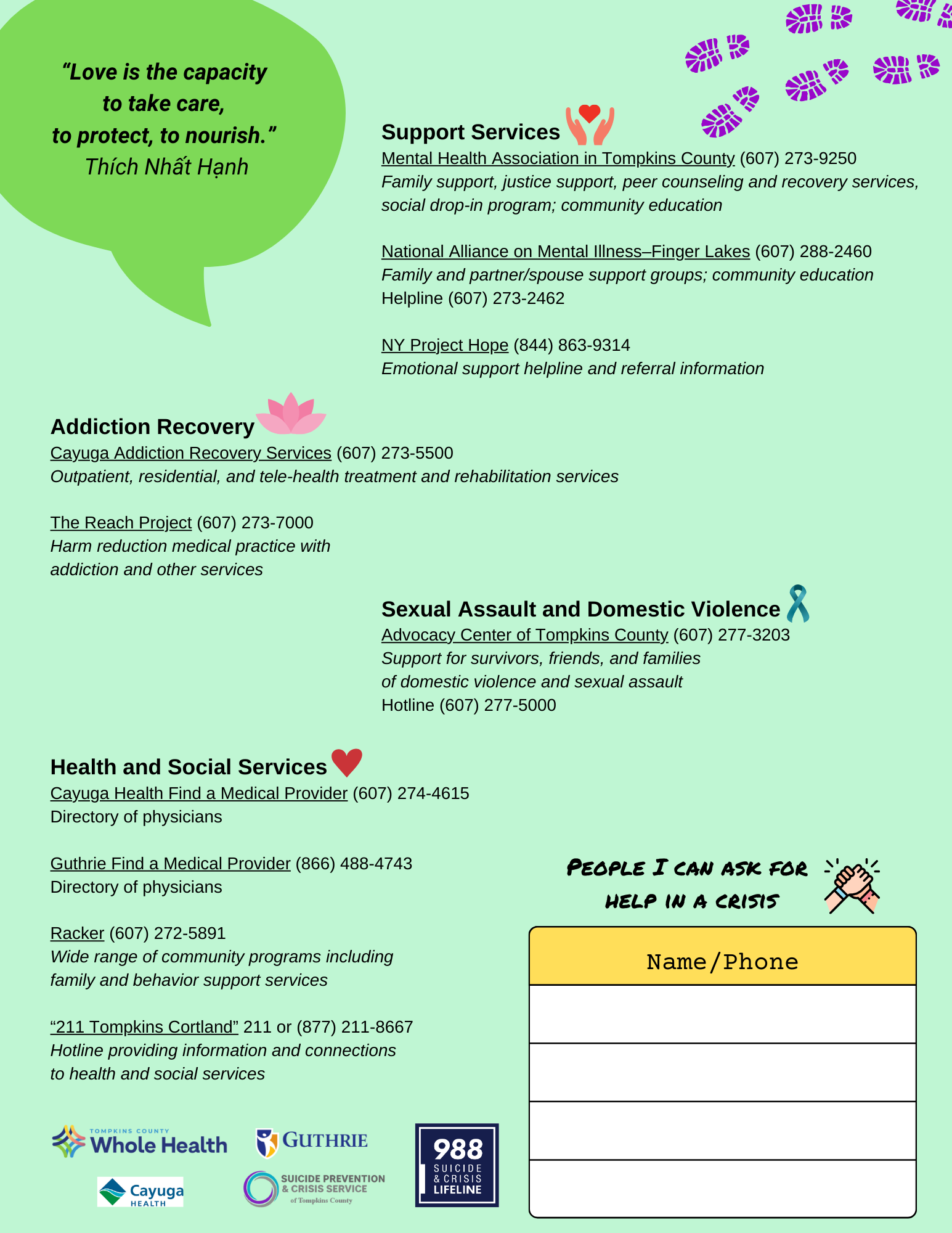
The guide is a hyperlinked listing of essential local services for suicide prevention, psychotherapy, addiction recovery, sexual assault and domestic violence, and support groups. Click on the links for more detailed information about available services and programs.
Mental health leaders in Tompkins County provided information about community services during The Sophie Fund’s 9th Annual Ithaca Cupcake Baking Contest on October 19.
Ithaca Free Clinic’s Norbert McCloskey briefs Cornell students about his agency’s work
Speaking at the Awards Ceremony, Norbert McCloskey, executive director of the Ithaca Free Clinic, which provides healthcare to individuals regardless of ability to pay, expressed gratitude for the support the agency receives from the community.
“I have had the honor for number of years now to work with an organization that does all that it can to make sure that people can access the healthcare that they need. We’re able to do that because all of our services are provided by community volunteers—everyone from MDs all the way down to the kind lady who comes in once a week and waters our plants,” McCloskey said.
Ithaca Free Clinic
McCloskey noted the connection between healthcare and mental health.
“Nothing really creates anxiety in the life of an individual than being ill and not being able to see a doctor, not being able to get the care that they need. Whether that care is primary family practice care, or acupuncture, or herbalism, or chiropractic, or occupational therapy, or seeing an optometrist to get the eyewear that they need in order to live a full and productive life.
“You probably wouldn’t be surprised to know that a significant number of people who come to our doors do suffer from a variety of mental health conditions. We are able to help them recognize that, and then steer them toward this vast array of organizations that we have in our community to get help that they need to live full, productive, happy, and joyful lives.”
Tiffany Bloss, executive director of the Suicide Prevention & Crisis Service of Tompkins County, said that her agency has been able to expand its services beyond its role as a local call center for the national 988 Suicide Prevention and Crisis Lifeline.
Suicide Prevention & Crisis Service of Tompkins County
She told the Awards Ceremony audience that SPCS now handles calls from 16 other New York State counties in addition to Tompkins County. She said her agency also launched a 24-hour “warm line” for people who are not in crisis yet need a person to talk to, as well as a 24-hour LGBTQ peer support line.
“It is so incredibly necessary. We need to have everyone talking about mental health all the time,” she said.
Bloss pointed people to SPCS’s newly redesigned website, “an incredible resource for mental health.”
“We really just want to get the word out and get people talking about mental health and suicide. Make it not a scary topic. We need to look at it like we look at our physical health,” she said.
Tompkins County Bullying Prevention Task Force
Mental Health Association in Tompkins County
American Foundation for Suicide Prevention — Greater Central New York
National Alliance on Mental Illness — Finger Lakes
America is experiencing a youth mental health and suicide crisis, as kids grow up in a world that is increasingly stressful and scary for them, according to Tiffany Bloss, executive director of the Suicide Prevention & Crisis Service of Tompkins County.
Tiffany Bloss speaks at youth mental health town hall
Bloss said that a quarter of the young people who die in the United States today take their own lives. She said the causes of suicide are complex, but pointed to stress factors such as the Covid-19 pandemic, academic pressures, addictive social media, poor family relationships, and financial anxiety.
“They are trying to navigate so many things in their world, and it is a scary place to be right now. And, with social media, there is no escape,” she said.
Bloss was a featured speaker at “Youth Mental Health & Wellness,” a community town hall hosted by the Tompkins County Suicide Prevention Coalition at the Tompkins County Public Library on October 5.
Bloss said that suicide is preventable, and emphasized the importance of normalizing discussions about mental health and being aware of warning signs that could be indicators of suicidal thoughts.
“We talk about our physical health all the time. We don’t ask about mental health. If your gut tells you that something is kind of going on for your youth, you’ve really got to ask them questions about suicide and see what we can do and open up that conversation,” she said.
Some of the warning signs Bloss described were not going out with friends anymore, failed relationships, slipping grades, changes in sleep patterns, excessive agitation or anger, and talking about dying by suicide.
She said that her agency and others in Tompkins County offer support services to address mental health challenges and emotional crises. She said that when people have serious concerns about themselves or someone else, it is wise to call 988 for the Suicide & Crisis Lifeline.
Melanie Little, director of Education and Youth Services at the Mental Health Association of Tompkins County, spoke about the importance of recognizing risk factors can make youth more vulnerable to developing a mental health disorder.
Melanie Little provides “Mental Health 101”
Among the risk factors are trauma, substance abuse, social marginalization, lack of supportive relationships, a physical illness or disability, and bullying, she said. She said mental disorders are increasingly common in youth, with 1 in 3 teens experiencing anxiety, 1 in 5 major depression, and 1 in 5 eating disorders.
Little emphasized the need to avoid perpetuating stigma around mental health. She listed some common examples of stigmatizing language that can be harmful to young people struggling with a disorder.
“Everyone has anxiety. Some people are just stronger than you are.”
“Therapy and medications are just scams. You don’t need them.”
“What do you mean you can’t get out of bed? It’s not like your legs aren’t working.”
“Kids can’t have mental illness. What have they got to worry about in life?”
“All women are a bit bipolar.”
Pat Breux, former director of School and Youth Initiatives at the Suicide Prevention Center of New York, discussed the vital role that schools play in preventing youth suicide.
“We take an approach that we call ‘confident, connected, caring school communities.’ What that means is everyone has a role to play. Everyone is challenged to have the competencies to notice, and know where, when, and how to access help for somebody when somebody’s in need,” she said.
Breux said schools can help educate parents about mental health starting when the children enter kindergarten. “We need to start having those conversations and preparing parents for the idea that mental health crises are pretty common by the time kids get into middle school or high school. And you need to be able to recognize that early and know how to get help for your kid,” she said.
In New York State last year, Breux said, more 5,000 children went to the emergency department for self-injurious behavior.
“About 2,000 of those kids ended up hospitalized. Where did the other 3,000 end up the next morning? Back in school. Were they fixed? No. There are kids who are going to struggle with suicidality who need access to education. They need to be able to move through life with that. How do we create the environment that those kids can be okay and make sure that we’re having some kind of eyes on them and they have access to the supports that they need at the level that they need?”
Breux distributed copies of “A Guide for Suicide Prevention for New York Schools,” a booklet prepared by the Suicide Prevention Center of New York that provides information for training school staff and educating parents as well as targeted and individualized interventions against suicide risk.
Town Hall organized by the Tompkins County Suicide Prevention Coalition
Other speakers at the town hall included Shawn Goodman, a psychologist in the Ithaca Central School District; Nicole Roulstin, Contact Center Manager for 211 Tompkins/Cortland; a student at Tompkins Cortland Community College; and Randy Brown, a member of the Tompkins County Legislature.
Goodman said several things inspired him to write the self-help manual. He said that he noticed that some people his age were still struggling with their childhood issues. And while he found books to help adults heal their issues, he couldn’t find any books for kids to help them before they became adults themselves.
“And I had kids coming in essentially asking for that, saying ‘This is going on with my dad. This is going on with my mom. I want my relationship to be better. How do I do that?’”
Goodman said his favorite strategy for living in a difficult family is to learn how to manage the situation, not the relationship.
“Many kids are holding the entire relationship and feeling responsibility for it. I tell kids it’s not your job to change your parents’ behavior. And even if it were your job, it’s mission impossible. So instead, just try and manage each situation. Throughout the book, if kids stick with it, I’m really hoping that they’re going to be building confidence in navigating difficult situations and improve their outcomes, one moment at a time,” he said.
The Tompkins Cortland Community College student shared a personal story of a suicidal crisis that began before she turned 11. She said that while she grew up in a supportive family, an attentive youth pastor and later a therapist played crucial roles in guiding her on a path to healing. “Sometimes talking to parents can be really challenging especially for a middle schooler,” she said.
The student noted that that while she is feeling fantastic and is enjoying college today, speaking about her ordeal is still difficult. She said she agreed to speak about it publicly for the first time at the town hall because “I thought it was a good idea to bring awareness.”
In her presentation, Roulstin provided an overview of how the 2-1-1 hotline can help Tompkins residents access a multitude of community services for support, including food, housing, transportation, health and mental health, utilities, legal aid, veteran needs, job listings, and tax assistance. She said the hotline uses a database with over 1,600 local, state, and federal resources.
Tompkins County Legislator Randy Brown: “The issue of our time”
Brown provided the town hall’s welcome remarks, saying “I think mental health and wellness is the issue of our time, more important than any other issue that I can think of. When I ran for the legislature a few years ago, it was the number one issue for me and still is. I think that there’s more that we can do as a county.”
The Tompkins County Suicide Prevention Coalition is comprised of health agencies, community organizations, and individual members who share a determination to prevent suicide deaths in our community. It is a collective of volunteers that strives for diverse and inclusive representation and encourages collaboration for achieving goals.
If you or someone you know feels the need to speak with a mental health professional, you can call or text the 988 Suicide and Crisis Lifeline at 9-8-8, or contact the Crisis Text Line by texting HOME to 741-741.
Messages of love and kindness and the beats of local bands filled the Ithaca Commons on September 21 at the annual Chalk the Walk kickoff event hosted by the Suicide Prevention & Crisis Service of Tompkins County (SPCS).
Chalk the Walk, among many activities marking National Suicide Prevention Month in September, included a call to action for community members to “grab your chalk, find a sidewalk” and write messages throughout the week on the themes of Strength in Connection, Hope is Real, It’s OK to Ask for Help, Resilience, and Be the Light.
“Chalk the Walk focuses on spreading awareness of being knowledgeable of your own mental health, challenging the stigma around talking about suicide, and spreading positivity and kindness,” said Tiffany Bloss, SPCS executive director. “Make others smile and feel a little less alone.”
The Chalk the Walk kickoff in the Commons kept spirits high with music by the Dart Brothers, The Galactic Wednesday Band, and AFTERMARKET.
The Dart Brothers at Chalk the Walk
Local organizations prioritizing mental health provided information about their services and answered questions from the public. They included SPCS, American Foundation for Suicide Prevention Greater Central New York, Tompkins County Whole Health, Advocacy Center of Tompkins County, YMCA of Ithaca and Tompkins County, Tompkins County Office for the Aging, and The Sophie Fund.
September is National Suicide Prevention Month, a reminder for all of us to learn more about mental illness, suicide, and what we can do to help those who may be struggling.
One of the keys is to end the stigma that too often holds us back. Many people experience suicidal thoughts, but keep it to themselves. Others may notice somebody in an emotional crisis, but are timid to ask if they are thinking of harming themselves.
Nobody is fated to take their own lives. Suicide deaths are preventable, and many recent advances enable us to better prevent them.
These advances include better screening tools for identifying people at risk of suicide, improved care management protocols, upgraded crisis response measures, and suicide-specific therapy treatment. The Tompkins County Suicide Prevention Coalition is urging local healthcare and behavioral health providers to adopt the Zero Suicide Model, which prescribes a package of best practices.
Another advance is the introduction in 2022 of the 988 Suicide & Crisis Lifeline, which provides free and confidential emotional support to people in suicidal crisis or emotional distress 24/7. You can also call 988 if you are concerned about a loved one, friend, or colleague. Veterans and/or their loved ones and friends can call 988 and then press 1 to reach the Veterans Crisis Line.
Locally, 988 calls go to the Suicide Prevention & Crisis Service of Tompkins County (SPCS), one of 200 call centers across the country. When people call or text 988, or connect to chat online, they are connected to trained counselors that are part of the Lifeline network. Trained counselors listen, understand how the caller’s problems are affecting them, provide support, and connect them to resources if necessary.
Besides connecting through 988, Ithaca-based counselors can be reached by dialing (607) 272-1616.
The Lifeline is funded by the U.S. Substance Abuse and Mental Health Services Administration (SAMHSA) and administered by Vibrant Emotional Health. SAMSHA provides a Partner Toolkit to help all of us publicize the 988 number and other suicide prevention services.
According to Lifeline, numerous studies have shown that 988 callers feel less suicidal, less depressed, less overwhelmed, and more hopeful after speaking with a Lifeline counselor.
“More people are understanding what it’s like to reach out for support and are becoming comfortable with that idea,” said Tiffany Bloss, SPCS executive director. “We are here, day or night. Call. Text. Website chat. Individuals can even email our helpline. We are here.”
The latest statistics from the U.S. Centers for Disease Control serve as a reminder of America’s mental health crisis. Despite improvements in care, we have not turned the corner in reducing suicide deaths in the way prevention tools have produced significant declines in deaths related to cancer and heart disease.
After declining in 2019 and 2020, suicide deaths increased approximately 5 percent in the United States in 2021. Provisional estimates indicate that suicide deaths further increased by 1 percent in 2022, according to the CDC. One encouraging indicator is that suicide deaths among people aged 10-14 declined by 13 percent and among people aged 15-24 by 9 percent.
Overall, suicide rates have risen more than 30 percent in the past two decades.
Take a moment to review the warning signs for suicide, as provided by the American Foundation for Suicide Prevention (AFSP). Be sure to get help for yourself or others if you see the signs. You may save a life.
According to AFSP, something to look out for when concerned that a person may be suicidal is a change in behavior or the presence of entirely new behaviors. This is of sharpest concern if the new or changed behavior is related to a painful event, loss, or change. Most people who take their lives exhibit one or more warning signs, either through what they say or what they do.
Warning sign: Talk
If a person talks about:
Killing themselves
Feeling hopeless
Having no reason to live
Being a burden to others
Feeling trapped
Unbearable pain
Warning sign: Behavior
Behaviors that may signal risk, especially if related to a painful event, loss or change:
Increased use of alcohol or drugs
Looking for a way to end their lives, such as searching online for methods
Withdrawing from activities
Isolating from family and friends
Sleeping too much or too little
Visiting or calling people to say goodbye
Giving away prized possessions
Aggression
Fatigue
Warning sign: Mood
People who are considering suicide often display one or more of the following moods:


You must be logged in to post a comment.