Free Training in Suicide Care: Sign Up Now!

The Sophie Fund is sponsoring free registration—and free continuing education credits (CEUs)—for healthcare professionals in Tompkins County to attend a two-day online training in suicide prevention featuring some of the nation’s leading experts.

The training program, “Suicide Safer Care in Clinical Practice Incorporating Current Best Practices,” takes place in the afternoons of Wednesday March 19 and Thursday March 20. It is organized by The Wellness Institute, which says the conference designed “to strengthen confidence and competence in providing caring, evidence-based services to clients with suicide risk.”

The training, which covers treating youth suicidality, lethal means counseling, brief interventions, treatment pathways, and other topics, is also sponsored American Foundation for Suicide Prevention, The Jed Foundation, the Education Development Center, Zero Suicide Institute, American Association of Suicidology, and CAMS-care. (See full program, below.)

Free registration and free continuing education credits for physicians, primary care clinicians, health and mental health clinicians, and clinical social workers serving Tompkins County is supported by a grant from The Sophie Fund.

To request a registration code for free registration, healthcare professionals can email The Sophie Fund at thesophiefund2016@gmail.com providing their 1) name, 2) email address, 3) degree level, and 4) place of employment (or name and address of practice, if self-employed).

Scott MacLeod, co-founder of The Sophie Fund, said his organization’s sponsorship of the Wellness Institute program for the fourth year in a row is intended to advance the Zero Suicide Model with healthcare providers. Thus far, The Sophie Fund has provided the free training for 180 clinicians in Tompkins County, including the counseling center staffs of Cornell University and Ithaca College.

Zero Suicide is an emerging standard designed to save lives by closing gaps in the suicide care offered by healthcare providers. The model provides a practical framework for system-wide quality improvement in areas including training staff in current best practices, identifying at-risk individuals through comprehensive screening and assessment, engaging at-risk patients with effective care management, evidence-based treatments, and safe care transition.

Suicide is the second leading cause of death among Americans aged 10-14 and 25-34. Recently, Tompkins County has averaged 12 suicide deaths per year. Another 1,600 parents, children, siblings, friends, and spouses may be impacted by the resulting psychological, spiritual, and/or financial loss.

An estimated 300 people in Tompkins County may attempt suicide every year. While rates for other causes of death have remained steady or declined, the U.S. suicide rate increased 35.2% from 1999 to 2018.

Suicide Safer Care in Clinical Practice: Incorporating Current Best Practices

Wednesday, March 19, 1-5 p.m.

Understanding Suicide to Prevent Suicide: A Clinical Framework

E. David Klonsky, PhD, Professor in the Department of Psychology, University of British Columbia

Jill Harkavy-Friedman, PhD, Senior Vice President of Research, American Foundation for Suicide Prevention

New-Generation Treatments (CRP, BCBT, etc.)

Craig Bryan, PsyD, ABPP, Trott Gebhardt Philips Endowed Professor and Professor of Psychiatry and Behavioral Health, Ohio State University College of Medicine

Assessment, Safety Planning, and Treatment Pathways

Gillian Murphy, PhD, New York-based psychotherapist; former Assistant Deputy Director for the National Suicide Prevention Lifeline (now 988)

Integrating Firearm Safety Discussions in Clinical Practice

Christopher Knoepke, PhD, MSW, LCSW, Research Assistant Professor, University of Colorado Anschutz Medical Campus.

Clients with Suicide Bereavement

Noam M. Schneck, PhD, Assistant Professor of Clinical Medical Psychology (in Psychiatry), Columbia University’s Department of Psychiatry and the New York State Psychiatric Institute

Thursday, March 20, 1-5 p.m.

The Human Element: Engaging Suicidal Clients

Jonathan Singer, PhD, LCSW, Professor, Loyola University Chicago School of Social Work

Creating Safe Spaces for Suicidality Disclosure

Lindsay Sheehan, PhD, Assistant Professor of Psychology and Associate Director of the Center on Health Equity, Education, and Research, Illinois Institute of Technology

Post-Crisis Reintegration

Marisa Marraccini, PhD, Tarbet Faculty Scholar in Education and an Associate Professor of School Psychology, University of North Carolina at Chapel Hill’s School of Education

Adapting Suicide Prevention for Telehealth

Lauren Khazem, PhD, Research Assistant Professor and clinical psychologist in the Department of Psychiatry and Behavioral Health, Ohio State University Wexner Medical Center

Addressing Substance Use in Suicide Prevention

Christina M. Sellers, PhD, LCSW, Associate Professor and Director of the Center for Innovation in Behavioral Health Education and Research, School of Social Work, Simmons University

Sleep-Focused Approaches to Youth Suicide Prevention

Sally Weinstein, PhD, Associate Professor of Clinical Psychiatry and Associate Director of the Center on Depression and Resilience, University of Illinois College of Medicine

Ask the Experts: What Works in Suicide Care (Q&A Session)

David Jobes, PhD, ABPP, Professor of Psychology and Associate Director of Clinical Training, Catholic University of America; Creator and Developer, Collaborative Assessment and Management of Suicidality (CAMS)

David A. Brent, MD, academic chief of child and adolescent psychiatry, UPMC Western Psychiatric Hospital

Jill Harkavy-Friedman, PhD, Senior Vice President of Research, American Foundation for Suicide Prevention

Learning Objectives:

Describe a model for understanding suicide and list factors that contribute to increased suicide risk.

Discuss how clinicians can engage in suicide prevention in their clinical practice.

Describe the suicidal mode and identify the mechanisms targeted by newly developed treatments in suicide prevention.

Identify core principles that can guide the suicide assessment process and brief interventions to implement to maintain client safety.

Articulate the role of firearms in suicide and how to integrate firearm safety conversations into suicide prevention efforts.

Explain the unique emotions that typify suicide bereavement and an approach to facilitate emotional acceptance.

Identify suicide-focused care models that fit a clinician’s clinical approach best and ways they can utilize their emotional reactions while working with suicidal individuals.

Describe client perspectives on disclosure of suicidality and strategies to increase comfort in disclosure.

Explain considerations for supporting students returning to school following suicide-related crises and how best practices for student reintegration may be generalized for community reintegration of individuals in all life stages.
Identify telehealth adaptations of suicide prevention strategies and how they may be implemented. (Describe imminent suicide risk assessment and responses.)

Explain the relationship between substance use and suicide and how substance use is a risk factor for suicide.

Describe developmental changes in sleep in adolescence, how to assess sleep quality in youth, and intervention strategies to improve sleep in adolescents that may be relevant for suicide prevention.

Demonstrate how to ask a client if they are experiencing suicidal thoughts, incorporate one new practice for suicide prevention, and develop a practice plan to put in effect when a person states they have been thinking about suicide.

Supporting Mental Health in Tompkins County Schools

Five Ithaca-based mental health organizations have launched a new resources guide, “Mental Health Support & Suicide Prevention for Schools in Tompkins County.”

Our kids are telling us: “We are struggling with mental health.” From the Covid-19 disruptions, academic pressures, and addictive social media to navigating adolescence in a time of political and economic uncertainty, it is a tough time for many to be young in America.

DOWNLOAD: Mental Health Support & Suicide Prevention for Schools in Tompkins County

National and local surveys of school students reflect the seriousness of the crisis. In a survey from the Centers for Disease Control and Prevention, 40 percent of high schoolers said they experienced persistent feelings of sadness or hopelessness. Twenty-nine percent reported poor mental health, and 20 percent said they had considered taking their own lives.

A survey of high school and middle school students in Tompkins County came up with similar patterns. Forty-seven percent said they felt anxious or worried on most days, 35 percent felt sad or depressed on most days, and 34 percent said that “sometimes I think life is not worth it.”

Such data prompt a call to action, to intensify our efforts to safeguard the mental well-being of children growing up in our precarious digital age.

In that spirit, the new resources guide was created by the Suicide Prevention & Crisis Service of Tompkins County, American Foundation for Suicide Prevention Greater Central New York, National Alliance on Mental Illness Finger Lakes, Mental Health Association in Tompkins County, and The Sophie Fund.

“Mental health and well-being start with our youth. At a young age, understanding warning signs and developing coping skills can provide a foundation for supportive strategies to be carried into adulthood. Talking about suicide is how we start supporting our young people,” said Tiffany Bloss, executive director of the Suicide Prevention & Crisis Service.

“Gaining an educated understanding of how to have conversations around crisis and suicide can save lives. Dedicating a matter of hours could save a youth’s life. We need to invest the time. We offer a variety of suicide prevention trainings and workshops at no cost to those who want to learn more.”

After providing a brief “Mental Health and Suicide 101” introduction, the resources guide details the education and training that the local organizations are ready to present to Tompkins school administrators, teachers, students, and parents.

If you have a comment, concern, or suggestion about mental health in Tompkins schools, please feel free to email it to The Sophie Fund: thesophiefund2016@gmail.com.

The resources guide compiles handbooks and toolkits to assist Tompkins schools in developing mental health promotion and bullying prevention programming as well as suicide prevention strategies in their school communities. The guide points to recommendations for youth use of social media issued by the U.S. Surgeon General and the American Psychological Association.

The organizations launched the resources guide in last September during Suicide Prevention Month and immediately distributed copies to the superintendents of the seven school districts in Tompkins County.

At the same time, the organizations requested an opportunity to meet directly with the superintendents and their leadership teams to provide a presentation on the support services available and respond to any concerns or questions they may have.

Tompkins school districts include Ithaca City School District; Lansing Central School District; Trumansburg Center School District; Newfield Central School District; Groton Central School District; Dryden Central School District; and TST BOCES. (As of late January 2025, three school districts had responded positively to the request.)

If you or someone you know feels the need to speak with a mental health professional, you can call or text the 988 Suicide and Crisis Lifeline at 9-8-8, or contact the Crisis Text Line by texting HOME to 741-741.

Worsening Trends in Teen Mental Health and Suicide

Our teens continue to experience poor mental health, according to a new U.S. government report. Female and LGBTQ+ students are far more likely to experience feelings of sadness and hopelessness, poor mental health, and suicidal thoughts and behaviors, the report said.

4 in 10 students said they feel sad or hopeless

“The percentages of students who experienced poor mental health and suicidal thoughts and behaviors are still concerningly high,” said the “Youth Risk Behavior Survey (YRBS) Data Summary & Trends Report 2013-2023” released in August by the U.S. Centers for Disease Control and Prevention.

The report said that 10-year trends are improving for some areas of adolescent health and well-being, including sexual risk behaviors and substance use.

“Unfortunately, the data show that from 2013 to 2023, almost all other indicators of health and well-being worsened. Data highlight worsening trends in protective sexual behaviors, experiences of violence, persistent sadness or hopelessness, and suicidal thoughts and behaviors,” the report said.

The CDC conducts the YRBS every two years among a nationally representative sample of public and private high school students. It provides the most recent surveillance data as well as 10-year trends and two-year changes in health behaviors and experiences. The survey tracks sexual behavior, substance use, violence, mental health, suicidal thoughts ad behaviors, social media use, and racism in schools.

According to the survey, 29 percent of respondents said they had poor mental health during the previous 30 days; and 4 in 10 said they experienced persistent feelings of sadness or hopelessness during the past year. Female teens were twice as likely as males—53 percent to 28 percent—to report those experiences; and nearly 2 in 3 students identifying as LGBTQ+ reported persistent sadness or hopelessness.

The survey results for suicidal behaviors were particularly concerning. Twenty percent of respondents said they seriously considered taking their own lives during the previous year; 16 percent reported making a suicide plan; and nearly 1 in 10 students said they had actually made a suicide attempt.

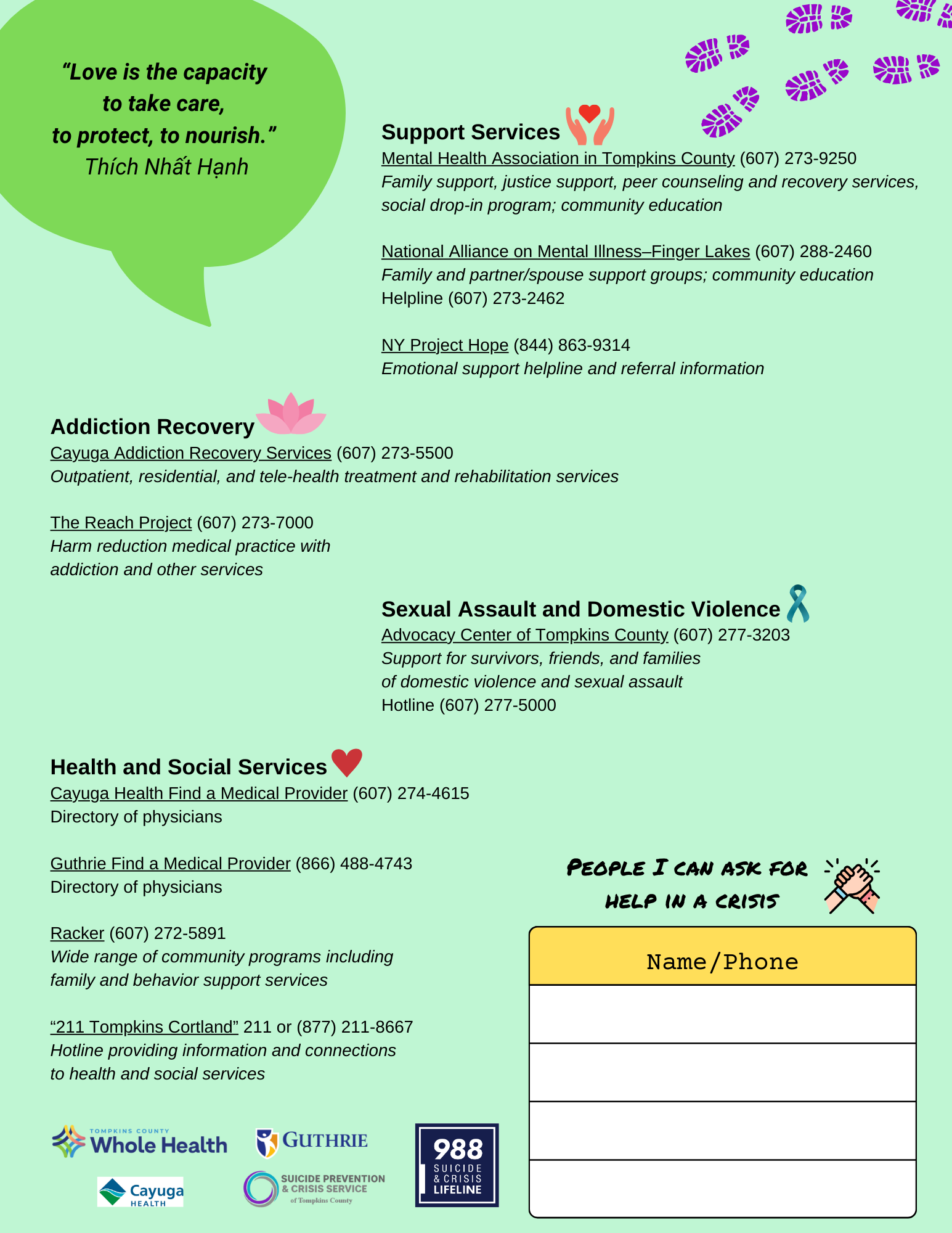
Looking for help? DOWNLOAD the 2024 Mental Health Support and Crisis Services guide for Tompkins County

There were some major disparities in sex, and sexual and gender identity. For example, 39 percent of female respondents reported poor mental health compared to 19 percent for males; 53 percent of teens identifying as LGBTQ+ reported poor mental health.

Female students were twice as likely to consider suicide than their male counterparts: 27 percent of females (and 41 percent of students identifying as LGBTQ+) said they considered making an attempt compared to 14 percent of males.

Similar wide disparities were seen in actual suicide attempts: 20 percent of LGBTQ+ students, 13 percent of female students, and 6 percent of male students reported trying to take their own lives.

The 2023 survey results showed a slight improvement, declining from 42 percent to 40 percent, over the previous two years in feelings of sadness and hopelessness. All other indicators remained static. However, the 10-year trends showed worsening teen mental health.

Forty percent of respondents reported persistent feelings of sadness and hopelessness in 2023, compared to 30 percent in 2013. Percentages of those with suicidal thoughts and behaviors also increased, though relatively slightly.

The new YRBS survey showed a slight decline from the 2021 survey, from 14 percent to 13 percent, in female teens reporting being forced to have sexual intercourse. The figure still represented an increase over the 10 percent reporting forced sex in 2013.

In other areas, the 2023 survey showed a marked drop over 10 years, from 47 percent to 32 percent, in students reporting having ever had sex; and also a decline from 15 percent to 6 percent in those reporting four or more lifetime sexual partners. Twenty-one percent of students reported being currently sexually active. However, the CDC said there were also concerning decreases in condom use, STD testing, and HIV testing.

Downward trends were seen in alcohol and drug use. Twenty-two percent of respondents said they currently drink alcohol, compared to 35 percent in 2013; percentages of using marijuana and illicit drugs declined from 23 percent to 17 percent, and 16 percent to 10 percent, respectively.

Currently, according to the survey results, 22 percent of respondents drank alcohol in the previous 30 days; 17 percent used marijuana.

In new area of the survey, 77 percent of respondents reported using social media several times a day. Only about half of students said they felt close to people at their school.

Also, 32 percent of students reported experiencing racism in school; the figures were highest for Asian teens (57 percent), multiracial teens (49 percent), Black teens (46 percent), and Hispanic teens (39 percent).

Read about the Youth Risk Behavior Survey 2011-2021

According to CDC, poor mental health can result in serious negative outcomes for the health and development of adolescents, which can last into adulthood. Young people who feel hopeless about their future are more likely to engage in behaviors that put them at risk for HIV, STDs, and unintended pregnancy, it says. Suicide risk not only places the life of the adolescent at risk, but is also a marker for experience with trauma and other mental health issues, CDC notes.

The CDC report called attention to the role that schools play in the lives and development of young people.

“Partnering with and supporting schools has the potential to reach large numbers of young people with strategies that can make a positive impact. Schools can provide education, connections, and environments that lessen the impact of negative life events and promote health and well-being,” the report said.

The CDC developed an “action guide” to assist schools with strategies it says are proven to improve the sexual, behavioral, and mental health of students: “Promoting Mental Health and Well-Being in Schools: An Action Guide for School and District Leaders.”

The guide outlines six strategies include increasing students’ mental health literacy; promoting mindfulness; promoting social, emotional, and behavioral learning; enhancing connectedness; providing psychosocial skills training and cognitive behavioral interventions; and supporting staff well-being. The strategies are stronger when supported at multiple levels by parents, families, and communities, according to the CDC.

If you or someone you know feels the need to speak with a mental health professional, you can call or text the 988 Suicide and Crisis Lifeline at 9-8-8, or contact the Crisis Text Line by texting HOME to 741-741.

Ithaca Town Hall: Youth Mental Health & Wellness

Our young people often put on a good face. But when they are anonymously surveyed about how they’re doing, their responses are concerning. In fact, more than one-third of middle and high school students in Tompkins County say they feel depressed or sad on most days and that “sometimes I think life is not worth it.”

“Our youth are struggling,” said town hall organizer Tiffany Bloss

A community town hall will be held at the Tompkins County Public Library on Saturday October 5 from 12:30 p.m. to 3:30 p.m. to throw light on the mental health challenges many of our young people are experiencing.

“Youth Mental Health & Wellness Town Hall,” organized and hosted by the Tompkins County Suicide Prevention Coalition, will provide information on how to support the well-being of our youth and hear testimonies from young community members themselves.

The event, part of the United in Kindness series of events in Tompkins County, will feature short Ted Talk-style presentations with an opportunity for Q&A with like local mental health leaders.

Speakers include Melanie Little, director of Training and Peer Education at the Mental Health Association of Tompkins County; Tiffany Bloss, executive director of Suicide Prevention & Crisis Service of Tompkins County; and Pat Breux, former director of School and Youth Initiatives at the Suicide Prevention Center of New York.

Shawn Goodman, an author and psychologist in the Ithaca Central School District, will share anecdotes from his new book, How to Survive Your Parents.

Organizer Tiffany Bloss, executive director of the Suicide Prevention & Crisis Service of Tompkins County, said she encouraged youth as well as their caregivers to attend.

“This is such an important topic for our community. Our youth are struggling. There are so many pressures in their lives that other generations did not have to deal with: heightened academic standards, family pressures, compromised school safety, a global pandemic, and the ever-present social media. At the town hall, we will be discussing all of these topics and more,” Bloss said.

Bloss emphasized the critical importance of tending to mental health in youth.

“Mental health is vital to the overall health and well-being in a person’s life. The adolescent years are crucial for developing social and emotional habits that build a foundation for mental well-being. These include good sleeping habits, regular movement of the body, self-care routines, developing problem-solving and interpersonal skills, and learning to manage emotions. Protective and supportive environments within the family, at school and in the wider community are important to a youth’s mental health,” Bloss said.

Town hall attendees are encouraged to register (not mandatory) at https://bit.ly/4gsfGr6.

The Tompkins County Suicide Prevention Coalition is comprised of health agencies, community organizations, and individual members who share a determination to prevent suicide deaths in our community. It is a collective of volunteers that strives for diverse and inclusive representation and encourages collaboration for achieving goals.

The coalition’s goals include:

Improving the quality and enhance the use of data sources and systems for suicide prevention in Tompkins County;

Advancing quality improvement for suicide care in all Tompkins County healthcare and behavioral health settings;

Reducing suicide attempts in the youth population, including students attending colleges in Tompkins County;

Reducing access to lethal means for suicide within high-risk demographic populations as determined by national, state, and local data;

And advocating for policies and practices designed to prevent suicides in the community.

Why We “Chalk the Walk”

Messages of love and kindness and the beats of local bands filled the Ithaca Commons on September 21 at the annual Chalk the Walk kickoff event hosted by the Suicide Prevention & Crisis Service of Tompkins County (SPCS).

Chalk the Walk, among many activities marking National Suicide Prevention Month in September, included a call to action for community members to “grab your chalk, find a sidewalk” and write messages throughout the week on the themes of Strength in Connection, Hope is Real, It’s OK to Ask for Help, Resilience, and Be the Light.

“Chalk the Walk focuses on spreading awareness of being knowledgeable of your own mental health, challenging the stigma around talking about suicide, and spreading positivity and kindness,” said Tiffany Bloss, SPCS executive director. “Make others smile and feel a little less alone.”

The Chalk the Walk kickoff in the Commons kept spirits high with music by the Dart Brothers, The Galactic Wednesday Band, and AFTERMARKET. 


The Dart Brothers at Chalk the Walk

Local organizations prioritizing mental health provided information about their services and answered questions from the public. They included SPCS, American Foundation for Suicide Prevention Greater Central New York, Tompkins County Whole Health, Advocacy Center of Tompkins County, YMCA of Ithaca and Tompkins County, Tompkins County Office for the Aging, and The Sophie Fund.