NAMI Walks for Mental Health

The on-again, off-again drizzle of a Saturday afternoon did not stop our Tompkins County mental health campaigners. Not for a second.

Nearly 200 supporters participated in the fundraising walk for the Finger Lakes chapter of the National Alliance on Mental Illness at Ithaca’s Stewart Park on May 3, bringing in more than $34,000 for NAMI’s support and education programs.

The walk begins!

The annual NAMI Walks event drew 31 fundraising teams led by Buoyant Punk which collected $3,524, Together We Walk with another $3,065, and EACMSI & IHS with $2,343.

Two new teams surpassed the $1,000 mark: Moral Psych Superstars comprising students from Cornell University and Ithaca High School brought in $2,027; TC Legs—members of the Tompkins County Legislature—raised $1,775.

NAMI-FL Executive Director Sandra Sorensen was the No. 1 individual fundraiser, with $2,884. But she noted that the event is about far more than collecting donations.

NAMI-FL’s Sandra Sorensen, Kathy Taylor, and Matt Taylor

“People gather, connections are made, stories are shared, laughter resonates, and smiles are endless. We walk to break the stigma around mental health and to bring the community together. We are very thankful for the huge impact this had on NAMI Finger Lakes,” said Sorensen. 

The other top individual fundraisers were Jae Sullivan, Hayden Plattus, Howard Reid, Bob Chiang, Meggin Rose, Chris Bobrowich, Aryeal Jackson, Lisa Gerber, and Dave Archer.

Click here to DONATE

NAMI Walks fundraising continues online until June 14

The 5K Runners: On Your Marks!

NAMI-FL Program Manager Jason Hungerford shared how he initially connected with and was aided by NAMI following the suicide death of his husband Jason Seymour in 2017.

NAMI-FL Program Director Jason Hungerford

“What NAMI gave me was an education to learn about the illness that he was battling. It allowed me to gain tools for empathy and communication rather than the resentment and fear and panic that I was feeling. And it really changed the course of my life,” he told the participants before the walk began. In 2021, Hungerford launched the spouse and partner support group at NAMI.

Other speakers included Kayla Matos, a member of Ithaca Common Council and acting Ithaca mayor, and Chloë Moore from the office of State Senator Lea Webb.

“Today, we walk just not in solidarity, but with purpose. Mental health impacts every part of our community, every family, every workplace, every individual. Yet too often it is overlooked. Events like this remind us that no one is alone and that that asking for help is a sign of strength,” said Matos.

“This work does not belong to one person or one organization. It takes all of us. You must keep having these conversations, uplifting one another, and supporting the grassroots organizations that are leading this work every day,” she added.

Ithaca Common Council Member Kayla Matos

Moore said that NAMI Walks events are an important way to break the stigma around mental health.

“What everybody’s doing here today and showing up like this is really an act of hope, which is something that we need a lot of right now. Coming together to have this hope around mental health is a really, really powerful form of community and resistance,” they said.

Beloved Ithaca artist SingTrece led the walkers out of the Stewart Park Pavilion with the song, “Stand by Me.”

“In a time like this, where we need to stand together, this is the perfect group to be around. Sometimes we feel alone, we don’t know who is there. I want you to think of the person that has stood by you, no matter what stage of life you have been in, what chapter of life you have been in, just knowing that you got that one person,” she said.

SingTrece sings “Stand by Me”

NAMI Walks funds programs such as peer-led support groups for family members, caregivers and loved ones of individuals living with mental illness.

NAMI Finger Lakes offers an array of peer-led programs that provide free education, skills training, and support. It operates a HelpLine where experienced volunteers answer calls for support and mental health resources. The number is (607 273-2462).

Several organizations supported the event with information tables, including the Suicide Prevention & Crisis Service of Tompkins County, American Foundation for Suicide Prevention Greater Central New York, Finger Lakes Independence Center, Sensory Nourishment, NY FarmNet, and The Sophie Fund. Be Kind Ithaca and Free Hugs Ithaca greeted the walkers en route with kindness and hugs.

Sponsors of the 2025 NAMI Walks include Segal & Sorensen, Cayuga Health, Tompkins Community Bank, Wegmans, Cornell University, CFCU Community Credit Union, Guthrie, Howard Hanna, and Cayuga Landscape. 

NAMI Finger Lakes is one of some 600 local affiliates of the national organization, a grassroots mental health organization founded in 1979 dedicated to building better lives for the millions of Americans affected by mental illness. NAMI says its mission is to educate, support, advocate, listen and lead to improve the lives of people with mental illness and their loved ones.

Check Out Your Mental Health Resources!

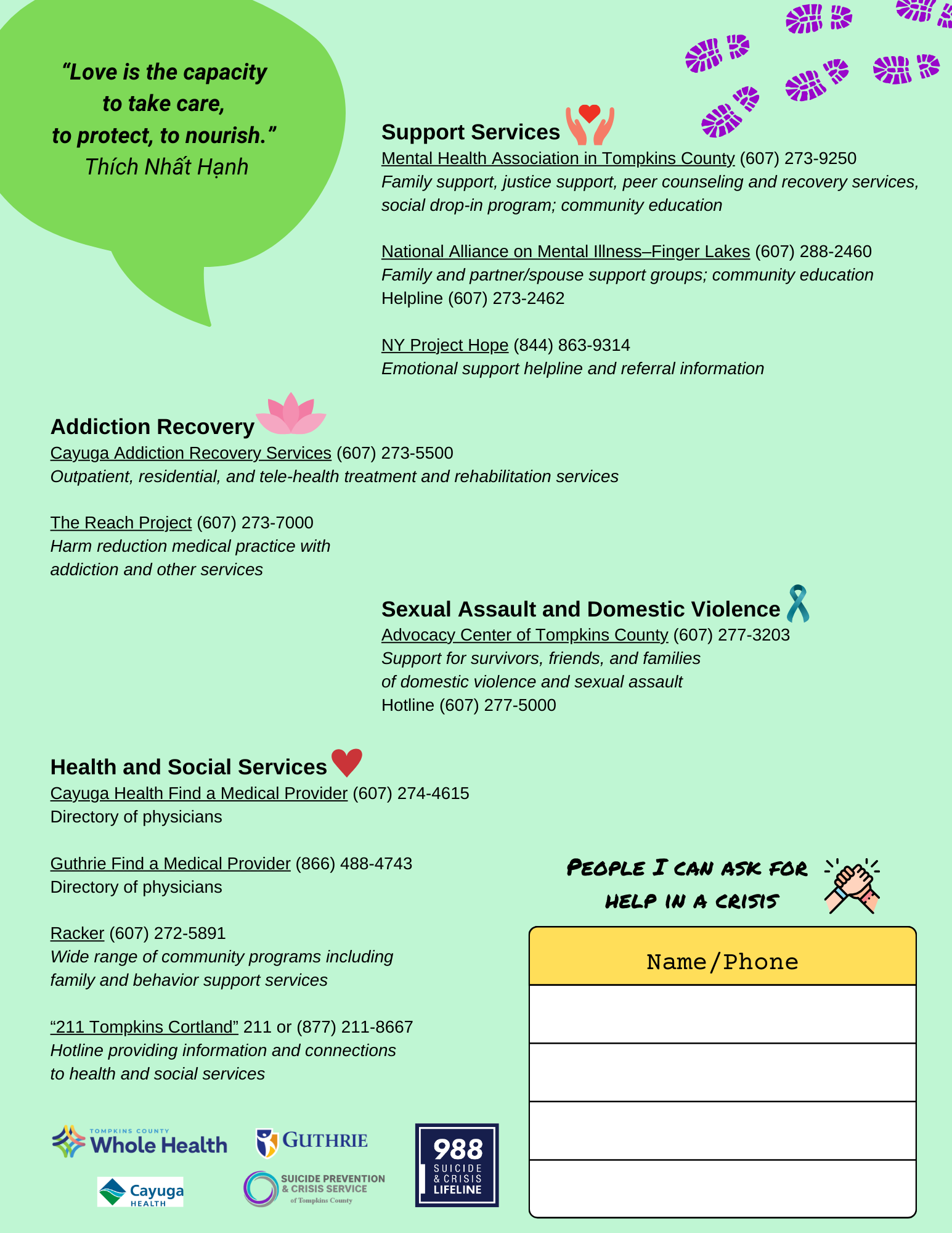
May is Mental Health Awareness Month! Take the time to know what mental health support resources are available locally if you live in Tompkins County. Resources are helpful to those experiencing mental health disorders, as well as to their families and friends. If you are at all concerned about your mental health, or about a loved one or someone you know, stay up to date about mental health and how to get help. You may even save a life.

DOWNLOAD PDF DOWNLOAD SHAREABLE Page 1 Page 2

Here are some national online resources to check out:

National Alliance on Mental Illness (NAMI)

NAMI is America’s largest grassroots mental health organization, with hundreds of local affiliates, state organizations, and volunteers who raise awareness and provide support and education.

Mental Health America

Mental Health America is a non-profit organization that provides mental health advocacy, education and services to a specific service area, such as a state, county or metropolitan area. Affiliates bring together mental health consumers, parents, advocates and service providers for collaboration and action to inform, support and enable mental wellness, and emphasize recovery from mental illness.

American Foundation for Suicide Prevention (AFSP)

AFSP’s mission is to save lives and bring hope to those affected by suicide. Its five core strategies include funding scientific research; offering educational programs for professionals; educating the public about mood disorders and suicide prevention; promoting policies and legislation that impact suicide and prevention; providing programs and resources for survivors of suicide loss and people at risk.

988 Suicide & Crisis Lifeline

Trained and caring counselors support people (or their loved ones) with mental health struggles, emotional distress, alcohol or drug use concerns. Free and confidential calls 24/7/365.

The Child Mind Institute

The Child Mind Institute is an independent, national nonprofit dedicated to transforming the lives of children and families struggling with mental health and learning disorders. Its teams work to deliver the highest standards of care, advance the science of the developing brain, and empower parents, professionals, and policymakers to support children when and where they need it most.

Society for the Prevention of Teen Suicide (SPTS)

Society for the Prevention of Teen Suicide is an information and training resource for community and professional organizations, educators, and parents. SPTS’s aim is to reduce the number of youth suicides and attempted suicides by encouraging public awareness through the development and promotion of educational training programs.

The Trevor Project

The Trevor Project is the leading national organization providing crisis intervention and suicide prevention services to lesbian, gay, bisexual, transgender, and questioning (LGBTQ) young people ages 13-24.

The Steve Fund

The Steve Fund is the nation’s only organization focused on supporting the mental health and emotional well-being of college students of color. It works with colleges and universities, outstanding non-profits, researchers, practitioners, and with groups serving diverse populations to stimulate dialogue and promote effective programs and strategies that build understanding and assistance for the mental and emotional health of the nation’s students of color as they enter, matriculate in, and transition from higher education.

It’s Better Together! Ithaca’s Fun Fair for Mental Health!

“Better Together for Mental Health,” a free community-wide celebration, is back for its third iteration on Saturday May 10 from 11 a.m. – 2 p.m. in Ithaca’s Stewart Park. To mark Mental Health Awareness Month, the event is a fun day of free activities for all ages. Participate in mindful movement, dance, live music, street performances, workshops, free activities for kids including face-painting and carousel rides, indulge in free food offerings, and much more.

Free Carousel Rides at “Better Together”

Stewart Park will be abuzz with community organizations, mental health providers, instructors, and entertainers, creating a vibrant atmosphere for learning, laughter, and connection. Explore and learn about mental health, discover ways to support yourself, and connect with others. 

 “This will be our third year of Better Together, and we cannot wait for the community to join us again this year,” said Jaydyn McCune, co-chair of the planning committee. “This event highlights things we can all do on a daily basis to help keep ourselves and others mentally healthy. We encourage everyone to come out and join us to celebrate wellness. Let’s make mental health a collective priority, because we are truly ‘Better Together.’” 

Representatives from 50 different community organizations will be spread out along the walking path of the park between the large and small pavilions, to share information about their programs as well as provide wellness-based activities, such as arts and crafts, “make your own stress ball,” lawn games, food sampling and more.

Stewart Park’s carousel rides will be available at no cost for the duration of the event, with special thanks to McCutcheon, Patel, Livermore and Associates for their generous sponsorship.

Planned performances and mental health practices will take place throughout the day at the Large Pavilion. This year’s event will include performances by local favorites, including Rootstock, Cakebatter, SingTrece, RDF, Jack Brown, and Thousands of One. 

The Small Pavilion will be transformed into the Family Activities Pavilion, sponsored in part by The Sophie Fund. This space will host a multitude of children-focused activities, story-telling, crafts and games.

There will be multiple food vendors on-site, providing free food for all in attendance, thanks to the generous event sponsors. Food vendors include Catering by Luna Inspired Street Food, Yxi’s Arepas & Gorditos, Meg -A-Moo’s Ice Cream, Via’s Cookies, Babe’s Burger, and Funk ‘n Waffles.

“Better Together for Mental Health” is grateful for the support of its many sponsors, partners, and supporters:

Cayuga Health; CFCU Community Credit Union; Guthrie; True Insurance; Community Foundation of Tompkins County; Friends of Greg Eells; Health & Unity for Greg (HUG); Sciarabba Walker & Co.; The Sophie Fund; Therm; Tompkins Financial; McCutcheon, Patel, Livermore, and Associates; Vicki and Jay Williamson of Northwestern Mutual; Wegmans; Carla and Steve Fontana; Gene Yarussi; and numerous others.

On May 3, Let’s Walk with NAMI!

May is Mental Health Awareness Month, an opportunity to celebrate and support the providers, caregivers, educators, advocates, and other dedicated souls who aid mental health and wellness in our community.

Ithaca Walking for NAMI in 2024

That’s why 200 or so mental health champions will participate in a fundraising walk for the Finger Lakes chapter of the National Alliance on Mental Illness (NAMI) at Ithaca’s Stewart Park on May 3 from 3-6 p.m.

Click here to be a sponsor, become a fundraiser, donate to a team, or sign up to join the NAMI Walk. This year’s goal is to raise $50,000.

The NAMI Walk funds programs such as peer-led support groups for family members, caregivers and loved ones of individuals living with mental illness.

NAMI Finger Lakes also offers an array of peer-led programs that provide free education, skills training, and support. It operates a HelpLine where experienced volunteers answer calls for support and mental health resources. The number is (607) 273-2462.

Just as important, the event is an occasion for those affected by mental illness to share community and draw strength from solidarity.

“Engaging with NAMI, talking to my friends about mental health, and being part of a greater community of trusting, stigma-breaking people has made me feel ‘not alone,’” said Sandra Sorensen, the chapter’s executive director.

“My team walks in memory of my late husband Michael, who died by suicide in May of 2021. Michael was afraid of stigma and lived a life hiding from his mental health issues,” she said.

In-person Walk registration begins at 3 p.m., and the event provides a 1-mile walking route and a fun 5K route for runners.

Despite the serious subject matter, the annual NAMI Walk is a joyful event that includes lawn games and face painting for kids of all ages. NAMI Finger Lakes is joined by local mental health partners who set up information tables about mental health resources available in the community.

“I have been profoundly moved by the support NAMI Finger Lakes has been able to give to so many people,” said Meggin Rose, a chapter board member.

“I have talked with many, many people who have told me that they no longer feel alone, that they now have hope and are acquiring the tools they need to navigate their own, or their loved one’s mental health challenges.”

One of this year’s walkers is Hayden Plattus, a NAMI volunteer through a course at Cornell University. “Having seen first-hand the challenges of providing mental health support, I became determined to raise funds for NAMI and spread its resources to more families,” she said.

Sponsors of the 2025 NAMI walk include Segal & Sorensen, Cayuga Health, Tompkins Community Bank, Wegmans, Cornell University, CFCU Community Credit Union, Guthrie, and Cayuga Landscape. 

NAMI Finger Lakes is one of some 600 local affiliates of NAMI, a national mental health organization founded in 1979 dedicated to building better lives for the millions of Americans affected by mental illness. NAMI says its mission is to educate, support, advocate, listen and lead to improve the lives of people with mental illness and their loved ones.

Free Training in Suicide Care: Sign Up Now!

The Sophie Fund is sponsoring free registration—and free continuing education credits (CEUs)—for healthcare professionals in Tompkins County to attend a two-day online training in suicide prevention featuring some of the nation’s leading experts.

The training program, “Suicide Safer Care in Clinical Practice Incorporating Current Best Practices,” takes place in the afternoons of Wednesday March 19 and Thursday March 20. It is organized by The Wellness Institute, which says the conference designed “to strengthen confidence and competence in providing caring, evidence-based services to clients with suicide risk.”

The training, which covers treating youth suicidality, lethal means counseling, brief interventions, treatment pathways, and other topics, is also sponsored American Foundation for Suicide Prevention, The Jed Foundation, the Education Development Center, Zero Suicide Institute, American Association of Suicidology, and CAMS-care. (See full program, below.)

Free registration and free continuing education credits for physicians, primary care clinicians, health and mental health clinicians, and clinical social workers serving Tompkins County is supported by a grant from The Sophie Fund.

To request a registration code for free registration, healthcare professionals can email The Sophie Fund at thesophiefund2016@gmail.com providing their 1) name, 2) email address, 3) degree level, and 4) place of employment (or name and address of practice, if self-employed).

Scott MacLeod, co-founder of The Sophie Fund, said his organization’s sponsorship of the Wellness Institute program for the fourth year in a row is intended to advance the Zero Suicide Model with healthcare providers. Thus far, The Sophie Fund has provided the free training for 180 clinicians in Tompkins County, including the counseling center staffs of Cornell University and Ithaca College.

Zero Suicide is an emerging standard designed to save lives by closing gaps in the suicide care offered by healthcare providers. The model provides a practical framework for system-wide quality improvement in areas including training staff in current best practices, identifying at-risk individuals through comprehensive screening and assessment, engaging at-risk patients with effective care management, evidence-based treatments, and safe care transition.

Suicide is the second leading cause of death among Americans aged 10-14 and 25-34. Recently, Tompkins County has averaged 12 suicide deaths per year. Another 1,600 parents, children, siblings, friends, and spouses may be impacted by the resulting psychological, spiritual, and/or financial loss.

An estimated 300 people in Tompkins County may attempt suicide every year. While rates for other causes of death have remained steady or declined, the U.S. suicide rate increased 35.2% from 1999 to 2018.

Suicide Safer Care in Clinical Practice: Incorporating Current Best Practices

Wednesday, March 19, 1-5 p.m.

Understanding Suicide to Prevent Suicide: A Clinical Framework

E. David Klonsky, PhD, Professor in the Department of Psychology, University of British Columbia

Jill Harkavy-Friedman, PhD, Senior Vice President of Research, American Foundation for Suicide Prevention

New-Generation Treatments (CRP, BCBT, etc.)

Craig Bryan, PsyD, ABPP, Trott Gebhardt Philips Endowed Professor and Professor of Psychiatry and Behavioral Health, Ohio State University College of Medicine

Assessment, Safety Planning, and Treatment Pathways

Gillian Murphy, PhD, New York-based psychotherapist; former Assistant Deputy Director for the National Suicide Prevention Lifeline (now 988)

Integrating Firearm Safety Discussions in Clinical Practice

Christopher Knoepke, PhD, MSW, LCSW, Research Assistant Professor, University of Colorado Anschutz Medical Campus.

Clients with Suicide Bereavement

Noam M. Schneck, PhD, Assistant Professor of Clinical Medical Psychology (in Psychiatry), Columbia University’s Department of Psychiatry and the New York State Psychiatric Institute

Thursday, March 20, 1-5 p.m.

The Human Element: Engaging Suicidal Clients

Jonathan Singer, PhD, LCSW, Professor, Loyola University Chicago School of Social Work

Creating Safe Spaces for Suicidality Disclosure

Lindsay Sheehan, PhD, Assistant Professor of Psychology and Associate Director of the Center on Health Equity, Education, and Research, Illinois Institute of Technology

Post-Crisis Reintegration

Marisa Marraccini, PhD, Tarbet Faculty Scholar in Education and an Associate Professor of School Psychology, University of North Carolina at Chapel Hill’s School of Education

Adapting Suicide Prevention for Telehealth

Lauren Khazem, PhD, Research Assistant Professor and clinical psychologist in the Department of Psychiatry and Behavioral Health, Ohio State University Wexner Medical Center

Addressing Substance Use in Suicide Prevention

Christina M. Sellers, PhD, LCSW, Associate Professor and Director of the Center for Innovation in Behavioral Health Education and Research, School of Social Work, Simmons University

Sleep-Focused Approaches to Youth Suicide Prevention

Sally Weinstein, PhD, Associate Professor of Clinical Psychiatry and Associate Director of the Center on Depression and Resilience, University of Illinois College of Medicine

Ask the Experts: What Works in Suicide Care (Q&A Session)

David Jobes, PhD, ABPP, Professor of Psychology and Associate Director of Clinical Training, Catholic University of America; Creator and Developer, Collaborative Assessment and Management of Suicidality (CAMS)

David A. Brent, MD, academic chief of child and adolescent psychiatry, UPMC Western Psychiatric Hospital

Jill Harkavy-Friedman, PhD, Senior Vice President of Research, American Foundation for Suicide Prevention

Learning Objectives:

Describe a model for understanding suicide and list factors that contribute to increased suicide risk.

Discuss how clinicians can engage in suicide prevention in their clinical practice.

Describe the suicidal mode and identify the mechanisms targeted by newly developed treatments in suicide prevention.

Identify core principles that can guide the suicide assessment process and brief interventions to implement to maintain client safety.

Articulate the role of firearms in suicide and how to integrate firearm safety conversations into suicide prevention efforts.

Explain the unique emotions that typify suicide bereavement and an approach to facilitate emotional acceptance.

Identify suicide-focused care models that fit a clinician’s clinical approach best and ways they can utilize their emotional reactions while working with suicidal individuals.

Describe client perspectives on disclosure of suicidality and strategies to increase comfort in disclosure.

Explain considerations for supporting students returning to school following suicide-related crises and how best practices for student reintegration may be generalized for community reintegration of individuals in all life stages.

Identify telehealth adaptations of suicide prevention strategies and how they may be implemented. (Describe imminent suicide risk assessment and responses.)

Explain the relationship between substance use and suicide and how substance use is a risk factor for suicide.

Describe developmental changes in sleep in adolescence, how to assess sleep quality in youth, and intervention strategies to improve sleep in adolescents that may be relevant for suicide prevention.

Demonstrate how to ask a client if they are experiencing suicidal thoughts, incorporate one new practice for suicide prevention, and develop a practice plan to put in effect when a person states they have been thinking about suicide.